
Cancel and rebook at a lower rate: what dropping your hotel price really costs
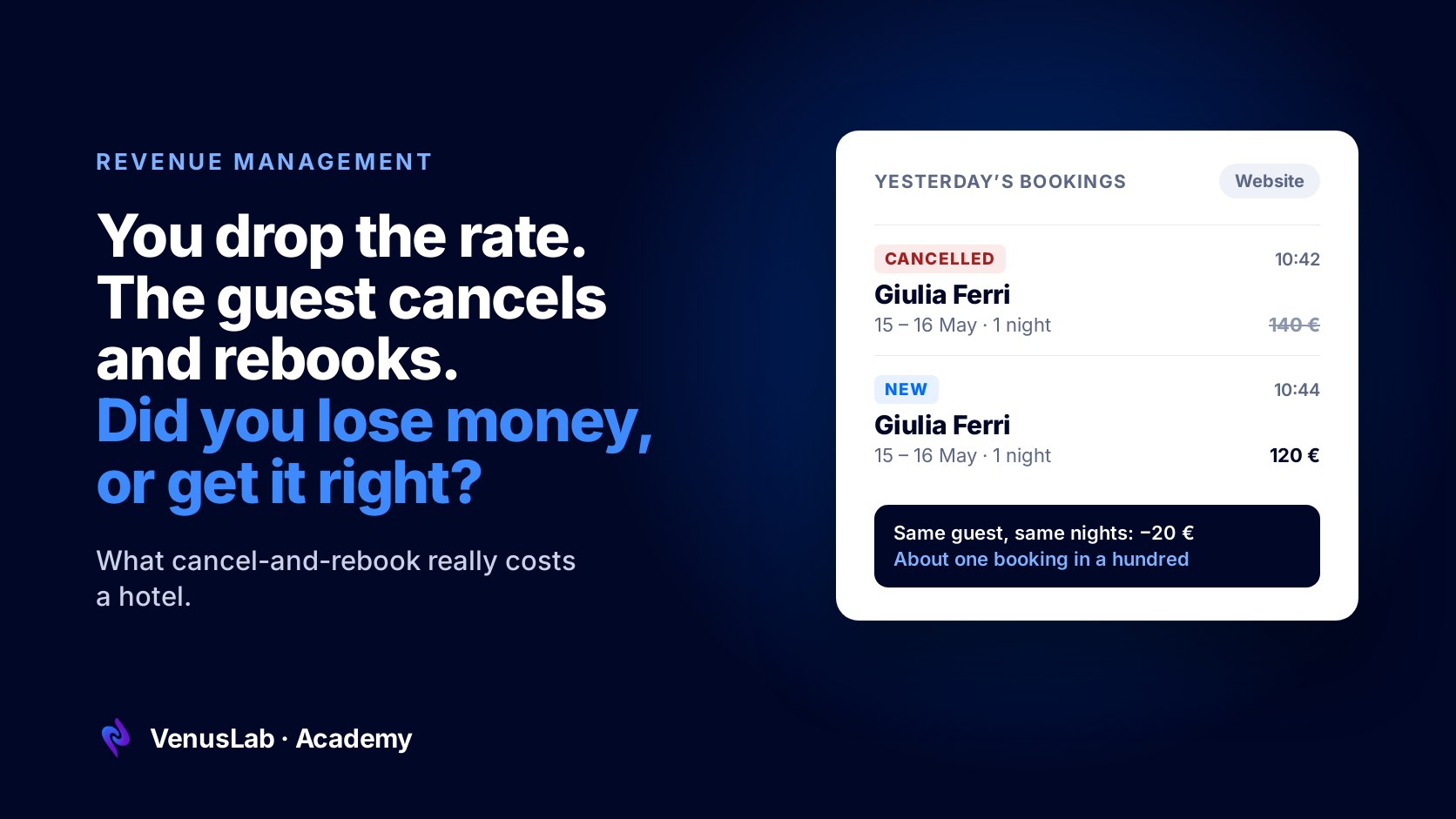
On Tuesday morning the rate for a Saturday in May drops by twenty euros. The date is behind and there are plenty of empty rooms. On Wednesday, two lines appear one above the other in the booking list: a cancellation and a new booking. Same name, same nights, twenty euros less.
This is the scene that worries anyone who lowers a price. The guest who had already chosen the hotel pays less, and the room sold is the same. Occupancy does not move, revenue goes down.
This year a study from NOVA University Lisbon tried to measure the phenomenon on a large scale. It produced a line that is now widely quoted: one cancellation in thirteen is a guest rebooking at a lower rate. Put that way, it sounds like a haemorrhage.
Read in full, the study’s numbers are less alarming than that line. And on data from Italian hotels the result is similar: the risk is real, but it weighs little, and it depends mostly on how and when the rate is lowered.
What the Lisbon study measured
Data and method
The study is by Martyna Kmiecik and Nuno Antonio and was published in the International Journal of Hospitality Management, a peer-reviewed scientific journal. It uses more than two million bookings from 628 Portuguese properties, between 2022 and 2024, all from the same property management system.
The authors looked for pairs made of a cancellation and a new booking at the same property. The two bookings had to share the arrival date and the number of guests. The second had to be cheaper, and recorded no more than one minute away from the cancellation, before or after.
The main numbers
The rebookings found are 7.55% of cancellations. Out of all bookings they are 0.94%, fewer than one in a hundred.
Guests who rebook pay on average 67 euros less per stay, 16% of the original price. Over three years the total difference is about 1.24 million euros. Against the value of all the bookings analysed, it is less than two euros in every thousand.
The phenomenon is growing: from 0.67% of bookings in 2022 to 1.09% in 2024. It is more frequent in cities, Lisbon and Porto, and almost halved in the Algarve. It concentrates in the low-season months: according to the authors, because that is when prices drop most often. At the most affected property, rebookings reach 4% of bookings.
What the study does not say
The authors themselves point out three limits.
The first: the data cannot show whether a price drop also brought in new guests. The study only counts what is lost. It cannot say whether lowering the rate was a mistake.
The second: cancellation terms and any penalties are missing. Part of the loss may already be covered.
The third: the data are anonymised and do not include the guest’s name. The authors cannot verify that the cancellation and the new booking come from the same person. They match them by arrival, number of guests, price and timing. For this reason they consider their estimates conservative.
That leaves the question of who rebooks. In half the cases the new booking is recorded before the cancellation. A one-minute window, the authors write, is consistent with operations run automatically through channel managers and system connections.
The study also notes that some services check the price after booking and rebook on their own when it drops. In those cases the saving may stay with the intermediary and never reach the guest.
One last clarification concerns the commentary that followed. The link with Google’s price alerts, launched in April 2026, is a hypothesis of those who commented on the study. The study stops in 2024 and does not measure it.
The same count on Italian properties
How we counted
The same check can be run on any hotel’s data. We ran it on the bookings of some twenty Italian properties we work with, almost 90,000 bookings, nine in ten from the last three years.
The method differs from the study’s. Our data include the guest’s name, but the cancellation has a date and no time. So we looked for a new booking with the same name and the same nights, created by the day after the cancellation.
How many there are, and how many cost less
Cancellations followed by a new booking from the same guest are about three in every hundred bookings. Most of them, however, have nothing to do with price.
Only three in ten are at a lower price. The rest are at the same price or higher. In all likelihood they are mostly changes, such as a different room or board, recorded as a cancellation and a new booking.
Lower-priced rebookings are about one booking in a hundred, as in Portugal. Leaving out changes in the number of rooms and moves from one channel to another, they fall to about half in a hundred. They weigh less than three euros in every thousand of room revenue.
The typical discount is around 15%. In half the cases the rebooking happens less than 17 days before arrival.
Guests who switch channel
Some of the lower-priced rebookings are a case of their own. The guest booked on Booking, then cancels and rebooks directly with the hotel, with a discount that is usually around 8%.
On the gross price it is a loss. On the net it often is not. Assuming a 17% commission, in almost nine cases out of ten the hotel earns more from the direct booking, discount included.
Booking remains the channel that brings in guests who do not know the hotel yet, and these rebookings do not change its role. But they should be counted separately, because the sum to do is on the net.
Did the price drop bring anyone in?
What happens around a rebooking
The Lisbon study could not answer this question. Our data can at least give an indication.
For each lower-priced rebooking we looked at the new bookings that arrived in the days around it, for the same night.
Overall, the new bookings were worth more than twice what was lost to rebookings. But in almost half the cases, no new booking arrived in the days around it.
Why this number needs caution
We do not know how many of those bookings would have arrived anyway, without the price drop. Nor do we know whether every lower-priced rebooking was caused by a price drop or by a different offer. It should be read as an indication.
Other research points the same way. A study by Abrate, Nicolau and Viglia in Tourism Management found that hotels that move their prices more tend to earn more.
A study published this year in Cornell Hospitality Quarterly, on an upscale American hotel, shows the other side. The higher the price paid, the more likely the guest is to cancel. Part of those cancellations is explained by guests who keep comparing the prices of nearby hotels even after booking.
The conclusion is that a price drop is not a mistake in itself. It becomes costly when it is made without checking how many flexible bookings that date already holds.
When dropping the rate pays, and when it does not
Three things to check first
Before a significant price drop, three pieces of information about the date are needed.
The first is how many flexible bookings are already there. They are the only ones that can cancel and rebook at no cost. If there are few, the risk is close to zero.
The second is whether demand is really there. Incoming enquiries, booking pace compared with previous years, prices in the area. A drop on a date that is stuck for lack of demand may bring in no one, and then all that is left is the discount given to those who had already booked.
The third is how many rooms are left to sell. With many empty rooms, a few rebookings are a small cost compared with the possible sales. With few empty rooms and many flexible bookings, the opposite is true.
When the price drop pays for itself
A price drop tends to pay for itself when there are many empty rooms, demand is there but price-sensitive, and few flexible bookings are already in. It is the typical case of a low-season date tackled early.
When another route is better
It is worth thinking twice when the date is already full of flexible bookings and enquiries have stalled. There, the price drop risks going mostly to guests who had already chosen the hotel.
In these cases there are alternatives that lower the price without showing it to those who have already booked:
- Add instead of taking away. Breakfast included, parking, late check-out: the public rate stays the same, the perceived value goes up.
- Closed offers. Rates for members, for mobile bookers, for past guests. They do not change the price seen by those who have already booked.
- A more attractive non-refundable rate. A real discount on the non-refundable rate moves some guests out of the risk of cancelling. The terms must be well written, as explained in Hotel cancellation policy: how to write it so it holds up in a card dispute.
- Small steps. The study’s authors suggest limiting price drops within two weeks of arrival to 10-15%, unless occupancy falls below a threshold set in advance.
This reasoning is only possible if the price reacts to what happens on the date. Hotels still working with a rate sheet set at the start of the season do not have this problem, but they have others, as explained in Having different prices is not the same as revenue management.
What to do this week
It can all be done with the property management system you already use.
- Count last year’s rebookings. Look for cancellations followed, on the same day, by a booking with the same name and the same nights. Split them into three groups: lower price, same, higher.
- Separate those who switched channel. For rebookings from an online travel agency to direct, compare the net, not the gross.
- Work out how much they weigh on room revenue. If you are at a few euros in every thousand, the problem is small. If you are well above, look at which dates and which price drops they cluster around.
- Before the next big price drop, check the flexible bookings. How many refundable bookings are already on that date, and what they are worth.
- Ask the front desk to flag them. A note on the new booking, «rebooked after cancellation», is enough to count them over time.
Conclusions
A cancellation followed by the same booking at a lower price exists and is growing. But it concerns about one booking in a hundred and weighs a few euros in every thousand of revenue.
Giving up price drops for fear of it would probably cost more. In our data, the sales that came in around price drops are worth more than the discounts given to those who rebooked, even if not all of them are due to the drop.
Before a big price drop, it pays to look at the date, starting with the flexible bookings already in. And to count rebookings now and then: it is the only way to know what they cost your own hotel.
Frequently asked questions
What is a cancel-and-rebook? It is when a guest cancels a booking and books the same nights again at the same hotel, usually because the price has dropped in the meantime. The hotel sells the same room and earns less.
How common is it? A study of more than two million Portuguese bookings found it in fewer than one booking in a hundred, 7.55% of cancellations. On data from some twenty Italian properties the result is similar.
How much does it cost a hotel? On average, guests who rebook pay about 15% less. On total revenue, both in the Portuguese study and in the Italian data, it weighs a few euros in every thousand.
So should I always drop the price? No. It pays when there are many empty rooms, demand is there and few flexible bookings are already in. With a date full of flexible bookings and stalled enquiries, it is better to add services or use closed offers.
How do I spot a rebooking in my system? Look for a cancellation and a new booking with the same name and the same nights, created on the same day. If the new one costs less, it is a lower-priced rebooking.
If a guest moves from Booking to a direct booking with a discount, do I lose money? Not always. On the gross price you earn less, but without commission the net is often higher. Compare the net.
Does a non-refundable rate solve the problem? It reduces it, because guests who choose it cannot cancel at no cost. It works if the discount is attractive enough and the terms are written clearly.
Is the phenomenon bound to grow? In the Portuguese study it went from 0.67% to 1.09% of bookings in two years. The authors read it as a behaviour that is spreading, helped by services that rebook automatically when the price drops.
A note on sources. The Portuguese data come from Martyna Kmiecik and Nuno Antonio, «Cancel, rebook, save: Revenue leakage from price cuts in hotels», International Journal of Hospitality Management, volume 135, 2026, open access; the share of booking value is our own calculation from the totals reported in the study. The other research cited is Abrate, Nicolau and Viglia, «The impact of dynamic price variability on revenue maximization», Tourism Management, volume 74, 2019, and Urrea, Huang and Zhang, «The Effect of Pricing on Cancelations at a High-End U.S. Hotel», Cornell Hospitality Quarterly, 2026. The Italian data come from about 89,000 bookings at 21 properties we work or have worked with, analysed in aggregate and anonymous form: matching is by guest name, nights and cancellation date; the net for guests moving to a direct booking assumes a 17% commission; there is no comparison with what would have happened without the price drop. They should be read as orders of magnitude, not as a statistical survey.