VenusLab

Choosing guide

Hotel management software: what it must do, and how to choose

Every PMS can record a booking. The difference shows up in what happens next: how many figures you have to reconcile, and how many decisions you make looking at spreadsheets you built yourself.

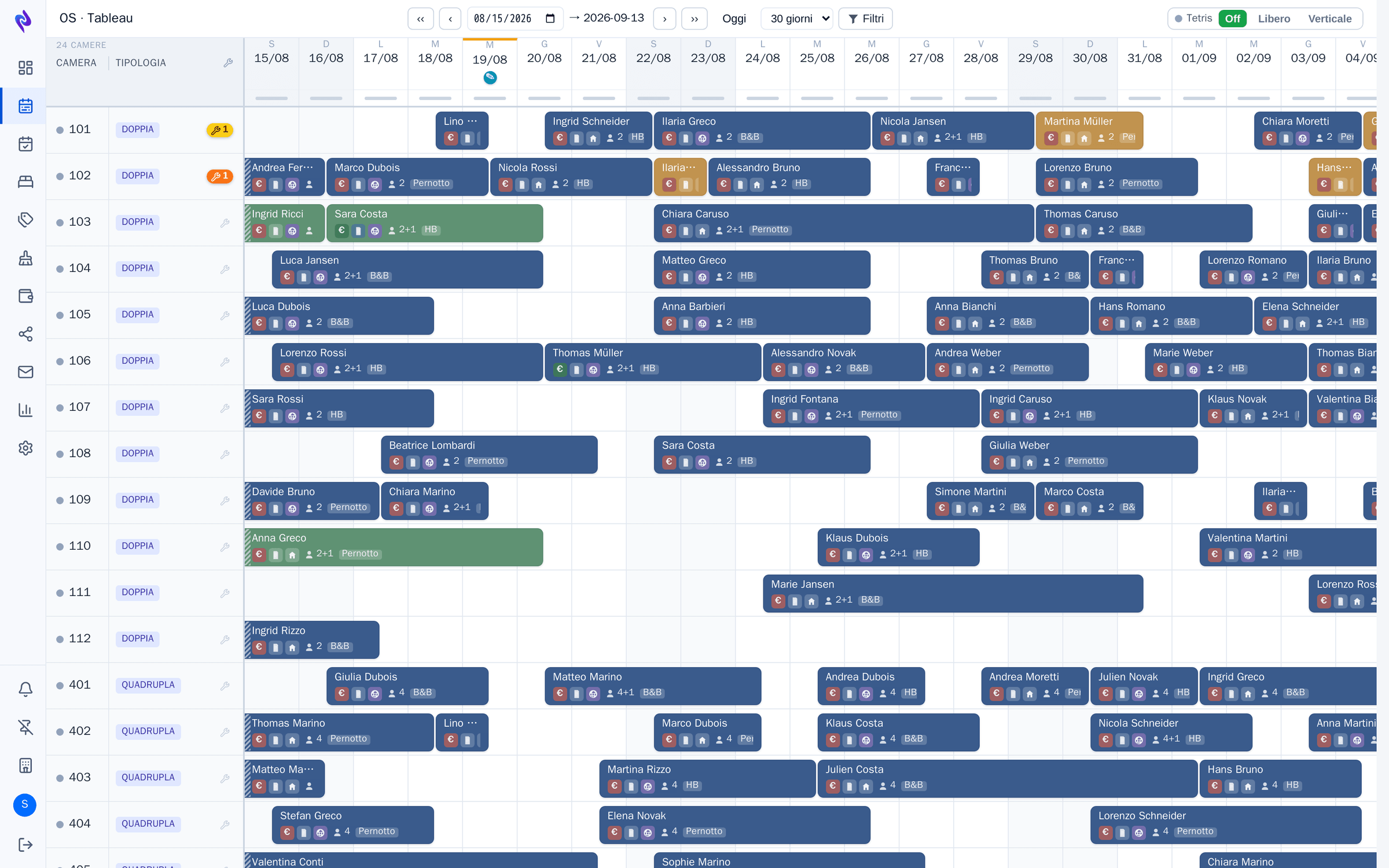
The room planning board in VenusLab OS

The problem

The problem is not what your PMS does. It is what it leaves you to do.

Almost nobody replaces a PMS because theirs «does not work». They replace it because they noticed that the programs are connected and the numbers still do not add up — and it usually shows in three symptoms.

Two figures for the same thing

The PMS and the pricing tool are connected, yet they give two different occupancy figures for the same month. Nobody got the sums wrong: each divides by its own rooms, and the connection carries the result, not the rule behind it.

The price gets through, the rules do not

The channel manager carries the rate everywhere. Minimum stays, closed dates, rooms held for one channel get through only in part, each under the name that program gives it — and what you change by hand often does not flow back.

Nobody has the margin by channel

The PMS knows which channel every booking came from, the accounts know what you spent. What is left per room sold, channel by channel, is in neither: you rebuild it yourself, when you have time.

The criteria

Five questions that separate a PMS from a booking ledger

Not «how many features it has», but how much work it takes away. They are the same five areas the check-up is built on, and you can put them to any vendor before signing.

Criterion Booking ledgerFull PMS
A figure is typed once The price reaches the channel manager, the restrictions only in part One inventory: typed into the PMS and pushed to the channels, restrictions included
Numbers about the future, not only the past no yes
The repetitive work is done by the system Lists to print Guest messages, housekeeping plan and meal sheet generated from the stays
Italian compliance included Tourist tax recomputed by hand Tourist tax and police reporting computed from data already entered
The books close on the same data no yes
Pricing and cost control as separate tools no Added when needed, and they connect to a third-party PMS too

«Booking ledger» is not an insult: for a small, steady property it can be enough. The comparison is there so you know what you are not buying.

The real cost

What is not in the quote

The list price is the easy part of the sum. Three items turn up afterwards, and together they often cost more than the subscription.

  • Migration. Who brings in guest records, history and future bookings, and in how long. If the answer is «you re-enter them», that is a cost of yours that appears nowhere.
  • The modules that look included. Channel manager, booking engine, document signing, statutory submissions: ask which are in the price and which are extra before, not at the first invoice.
  • People's time. Two weeks of real hand-holding are worth more than six months of manual, and it shows in the first month of actual use.

For the full picture of market costs — price bands per room, setup, the hidden items — there is a page of its own: how much a hotel PMS costs.

Where we come in

VenusLab OS

It is the PMS we built to answer those five questions with a yes: one inventory, numbers about the future, the repetitive work automated, and Italian compliance inside rather than beside. Pricing and cost control are separate tools (RatePilot and CostCore): switched on when needed, and they work on top of a PMS that is not ours.

Take a look at VenusLab OS →

Questions people actually ask us

How long does moving from one PMS to another take?

Two or three weeks for a single property, counting data migration and hand-holding. The long part is not technical: it is deciding which data is worth bringing along.

The right moment is low season, and the rule is never to switch with a full house.

Can I keep the channel manager I already have?

It depends which one. Some connect; others overlap with functions the PMS already has — and then you would be paying twice for the same work, with two versions of the truth about availability.

It is one of the first things to look at, before the price.

Is it worth it for an 8-room property?

It is worth it if you are the one doing the repetitive work. Room count matters less than it seems: a small property with many channels and many rates needs automation more than a large hotel with a single rate.

If you have few rooms, few channels and steady prices, a ledger can be enough — and we will tell you so.

Where does the data live, and is it ours?

It is yours, and you must be able to take it away. The question to put to any vendor is: «in what format do you export it, and what does that cost?». If the answer is vague, that is the answer.

What is the difference between a PMS and a hotel management system?

None: they are two names for the same thing. Vendors tend to reach for whichever sounds newer, which is a good reason to look at what the software does rather than at what it is called.

Before you switch, measure what you have

Ten questions, three minutes, and you know which two areas are worth acting on — which are not always the PMS.

Take the check-up